
The Hidden Marvel of Japan's Shimanami Kaido Cycling Route
Japan's Shimanami Kaido is a breathtaking route connecting islands through a series of bridges, but its creation involved accidental discoveries.
Introduction
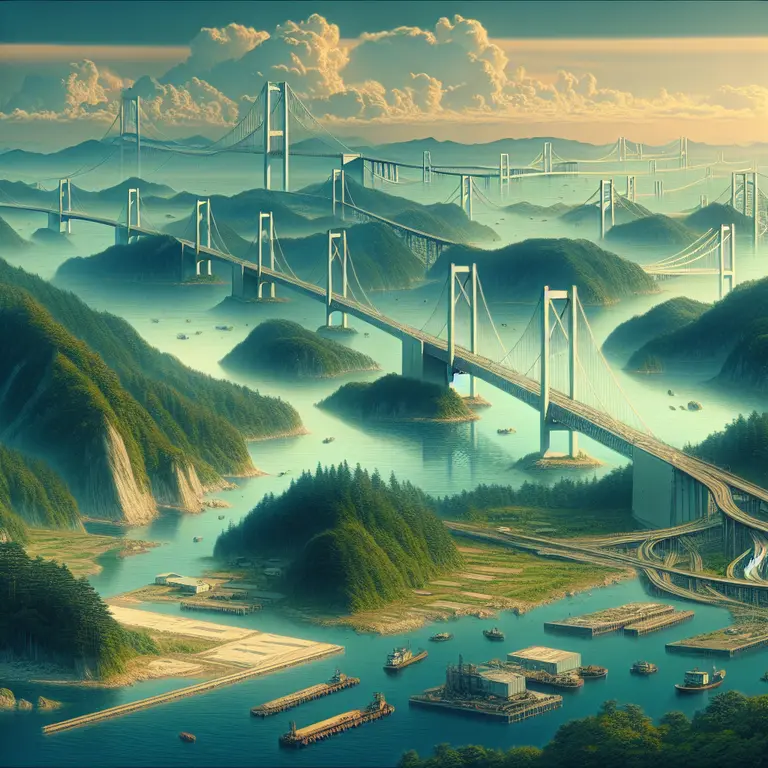
The Shimanami Kaido, formally designated as the Nishiseto Expressway, is one of the most remarkable feats of modern civil engineering in Asia. Stretching approximately 60 kilometers across the Seto Inland Sea, this corridor links the Japanese mainland island of Honshu to the island of Shikoku by threading through six smaller islands — Mukaishima, Innoshima, Ikuchijima, Omishima, Hakatajima, and Oshima — via a sequence of suspension, cable-stayed, and truss bridges of extraordinary scale and elegance. Completed in 1999 after more than a decade of planning and construction, the route was conceived primarily as an economic artery, designed to reduce dependence on ferry services and open the historically isolated communities of Shikoku to broader commerce and tourism.
What makes the Shimanami Kaido exceptional, however, is not merely its engineering ambition. The route has become globally celebrated as perhaps the finest dedicated cycling path in the world, drawing tens of thousands of riders annually who travel its dedicated lanes suspended high above tidal channels and citrus-scented hillsides. Yet beneath this well-photographed surface lies a far more layered story — one involving accidental geological finds, unexpected ecological revelations, submerged historical artifacts, and an unusually productive collision of scientific disciplines that the project’s original planners never anticipated. The Shimanami Kaido did not simply connect two islands. It uncovered, almost incidentally, a remarkable archive of Japan’s deep past.
Geological Finds and Underground Surprises
When engineers began conducting geological surveys in preparation for tunnel-boring and deep-foundation work beneath the seabed, they encountered rock formations far older and more complex than preliminary assessments had suggested. Sedimentary and metamorphic layers dating back tens of millions of years were exposed during excavation, offering geologists an unexpected window into the region's tectonic history. The Seto Inland Sea itself is the product of ancient geological upheaval — a drowned valley system shaped by subsidence and the shifting of tectonic plates over geological time — and the construction process essentially forced a detailed reckoning with that history.
Among the more practically significant discoveries were previously uncharted aquifers located beneath several of the islands. These underground water reserves, hidden within porous rock formations near the coastline, complicated certain phases of construction by introducing pressurized groundwater into excavation zones. However, the data gathered from these encounters proved enormously valuable to hydrological science, particularly in understanding how freshwater systems behave in coastal and island environments subject to tidal fluctuations and seismic activity. Engineers and hydrologists were compelled to develop new modeling techniques to manage these aquifers safely, techniques that have since informed infrastructure planning in similarly complex coastal regions across Southeast Asia and the Pacific.
The geological record exposed during construction also contributed meaningfully to ongoing debates about the pace and pattern of tectonic movement along the Median Tectonic Line, Japan’s longest and most seismically significant fault system. The Seto Inland Sea sits in close proximity to this fault, and the stratigraphic data gathered during the Shimanami project helped researchers refine existing models of how stress accumulates and dissipates in the region over long timescales.
Seabed Mapping and Marine Discovery
To plan the precise placement of bridge piers and underwater foundations, construction teams deployed sophisticated multibeam sonar systems capable of producing high-resolution three-dimensional maps of the seabed. The Seto Inland Sea is a relatively shallow and heavily trafficked body of water, and prior to this project, detailed bathymetric charts of its more complex inner channels were surprisingly incomplete. The sonar surveys filled those gaps in dramatic fashion, revealing underwater topographies of considerable scientific interest.
Several areas of the seabed showed formations consistent with hydrothermal or cold seep activity, environments known elsewhere in the world to support highly specialized communities of organisms adapted to chemosynthetic rather than photosynthetic energy sources. While the Seto Inland Sea does not host the dramatic deep-sea vents found in the open Pacific, the discovery of seep-like features in a semi-enclosed coastal sea prompted marine biologists to conduct follow-up investigations that identified previously undocumented benthic communities — organisms living on and just beneath the seafloor — in the affected areas.
The surveys also identified mineral-rich sediment zones of potential commercial interest, though these have remained largely unstudied due to the protected status of much of the Seto Inland Sea. Perhaps more importantly, the mapping work revealed the extent to which the seabed had been altered by centuries of human activity, including historical dredging, anchoring, and waste disposal associated with the maritime trade that once made this sea one of the busiest waterways in East Asia. These findings prompted international collaborations between Japanese oceanographic institutions and research bodies in South Korea, the United States, and several European nations, with the shared goal of developing better baseline data for marine conservation planning in semi-enclosed coastal seas worldwide.
Historical Artifacts and the Edo Period Beneath the Waves
Among the most culturally resonant discoveries made during the Shimanami Kaido’s construction were those made not by geologists or marine biologists, but by the divers tasked with inspecting and preparing the seabed for bridge foundation work. Working in the strong tidal currents that characterize the channels between the islands — currents that, in places like the Kurushima Strait, rank among the most powerful in Japan — these divers encountered accumulations of artifacts from Japan’s Edo Period, spanning roughly 1603 to 1868.
The Seto Inland Sea was, during the Edo Period, Japan's primary maritime highway, connecting the commercial capital of Osaka with the western provinces and the island of Shikoku. Thousands of cargo vessels, fishing boats, and official government ships traversed these waters annually, and it is now understood that a significant number of them foundered in the treacherous tidal channels that the Shimanami Kaido now bridges. The artifacts recovered by construction divers — including ceramic storage vessels, lacquerware fragments, iron tools, wooden structural elements, and personal items — represent the material remnants of this intensive maritime activity.
These objects were carefully documented and, where possible, preserved and transferred to local museums along the route, several of which have developed dedicated exhibitions around the finds. For historians and archaeologists, the discoveries offered rare physical evidence of trade patterns, craft production methods, and everyday material culture from a period that is extensively documented in written sources but less well represented in the archaeological record, particularly in maritime contexts. The finds have since attracted researchers from institutions in Japan, Europe, and North America who are working to reconstruct the economic geography of Edo-Period Japan through the lens of what its ships carried and where they were lost.
Ecological Implications and Biodiversity Conservation
The construction of large-scale infrastructure through a biologically sensitive marine environment inevitably carries ecological costs, and the Shimanami Kaido project was no exception. However, the process of environmental impact assessment and ongoing ecological monitoring that accompanied the project’s development also yielded several significant, largely unanticipated findings about the biodiversity of the Seto Inland Sea.
During site surveys conducted near the Kurushima-Kaikyo Bridge — a triple suspension bridge crossing the Kurushima Strait and one of the most technically demanding structures on the entire route — researchers identified a deep-water drop-off zone that had effectively functioned as an ecological refuge, sheltering species from the pressures of fishing, pollution, and coastal development that have affected much of the surrounding sea. Several invertebrate species documented in this zone were previously unknown to science, and their discovery prompted a broader reassessment of the Seto Inland Sea’s ecological value, which had previously been considered significantly degraded relative to its historical condition.
These findings contributed directly to the expansion of marine protected areas in the region and informed the development of new conservation guidelines for infrastructure projects in coastal marine environments. They also underscored a broader scientific point: that even heavily modified and industrially impacted marine environments can harbor pockets of extraordinary biological richness, particularly in areas where physical conditions — strong currents, unusual depth profiles, or reduced human access — have provided natural protection.
Conclusion
The Shimanami Kaido is far more than a feat of civil engineering or a celebrated cycling destination, though it is genuinely both. It is, in a deeper sense, a document of place — a structure whose creation required an extended, multidisciplinary engagement with the geology, hydrology, marine biology, history, and ecology of one of Japan’s most storied bodies of water. The accidental discoveries made during its construction — ancient rock formations, hidden aquifers, unknown marine species, and centuries-old shipwreck artifacts — were not incidental footnotes to the project’s main purpose. They became, in aggregate, a significant contribution to human knowledge across several fields simultaneously.
This quality of productive surprise is perhaps what distinguishes truly great infrastructure from merely functional infrastructure. The bridges of the Shimanami Kaido carry cyclists and motorists across a sea that turns out to be far older, stranger, and richer than anyone fully appreciated before the work of building across it began. That the route has become a destination for travelers seeking beauty and contemplation seems entirely appropriate in retrospect. There is much here worth contemplating.