
Catastrophic Molasses Spill: a Sticky Disaster in History
A large molasses storage tank burst and flooded the city in Boston in 1919.
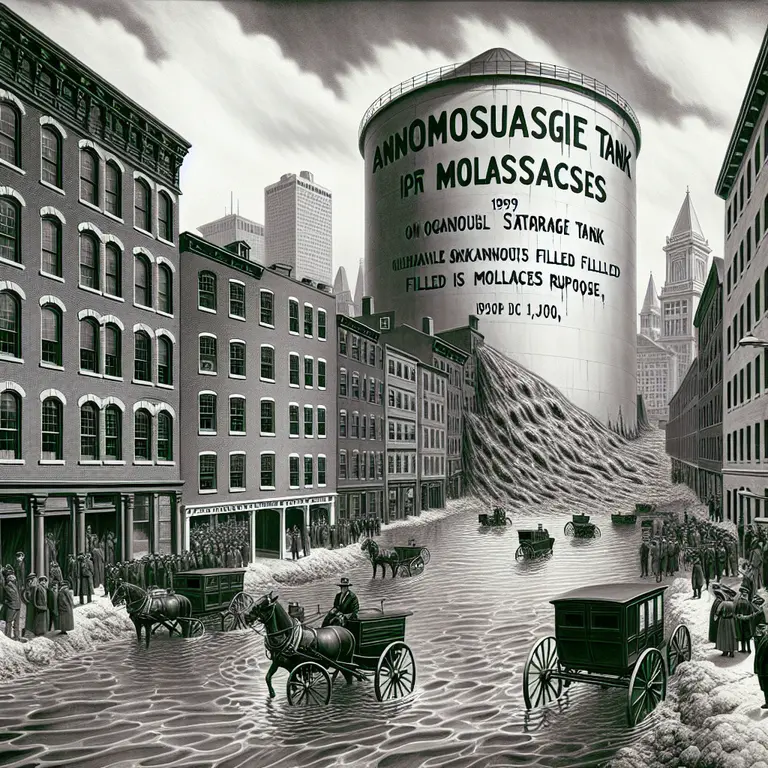
The Great Molasses Flood of 1919: Boston’s Strangest Disaster
On January 15, 1919, one of the most unusual industrial disasters in American history unfolded in the streets of Boston, Massachusetts. A colossal steel storage tank owned by the Purity Distilling Company, located in the city’s North End neighborhood, catastrophically ruptured and unleashed a torrent of thick, dark molasses onto the surrounding streets. The tank had been holding approximately 2.3 million gallons, or roughly 8.7 million liters, of the viscous liquid. When it gave way, it sent a wave of syrup surging through the neighborhood at an estimated speed of 35 miles per hour, or about 56 kilometers per hour. The disaster claimed the lives of twenty-one people, left more than a hundred others severely injured, and caused infrastructure damage that, when adjusted for modern inflation, amounts to approximately $100 million. What makes this event so remarkable is not merely its strange subject matter, but the deeper story of negligence, industrial ambition, and the physics of an underestimated substance that combined to produce one of history’s most improbable catastrophes.
The Tank and Its Contents
To understand why this disaster happened, it helps to first understand what the tank was being used for and why so much molasses was stored in such a densely populated area. The Purity Distilling Company, a subsidiary of United States Industrial Alcohol, used molasses as a primary ingredient in the production of industrial alcohol and rum. During the years surrounding World War One, demand for industrial alcohol was particularly high, as it was a critical component in the manufacture of munitions, including ammunition and explosives. This wartime demand incentivized companies to store enormous quantities of raw materials, often with little regard for the long-term structural consequences.
The tank itself was an engineering problem waiting to become a catastrophe. Standing approximately 50 feet tall and 90 feet in diameter, it had been constructed hastily in 1915 and showed signs of weakness almost from the beginning. Workers and residents in the surrounding area had reportedly noticed the tank leaking molasses for years before the disaster. Rather than addressing these warning signs with serious structural repairs, the company responded by painting the tank brown, a cosmetic measure that conveniently disguised the seeping liquid. Local children were said to collect the leaking molasses in cans and bring it home. The tank groaned and rumbled under pressure, and complaints from nearby residents were largely dismissed. This pattern of ignoring evidence of structural failure would prove fatal.
What Caused the Rupture
A combination of physical and environmental factors converged on January 15th to produce the disaster. In the days leading up to the rupture, the temperature in Boston had swung dramatically. After a prolonged cold spell, the temperature rose sharply, climbing from roughly 2 degrees Fahrenheit to approximately 40 degrees Fahrenheit within a short period. This sudden warming significantly affected the molasses in the tank. Molasses is a fermentable substance, and warmer temperatures accelerate fermentation, producing carbon dioxide as a byproduct. This increase in internal gas pressure, combined with the thermal expansion of the liquid itself, placed enormous additional stress on a tank that was already compromised.
Beyond the fermentation issue, investigators and engineers who later examined the disaster concluded that the tank had been fundamentally under-engineered from the start. The steel used in its construction was too thin to safely contain the volume of liquid it held, and the structural calculations that should have guided its design appear to have been inadequate. A recent shipment of molasses had also filled the tank to near capacity just before the disaster, adding to the pressure load. When the tank finally gave way, it did so with explosive force. The steel walls burst outward, sending metal fragments flying and creating a pressure wave that demolished nearby buildings and elevated rail structures. The molasses itself, released all at once, behaved less like a gentle syrup and more like a fast-moving wall of dense liquid.
The Physics of a Slow Killer
One of the most counterintuitive aspects of the Great Molasses Flood is how dangerous the substance itself proved to be, independent of the initial explosion. Many people assume that molasses, being thick and slow-moving under ordinary conditions, would not pose a serious threat to life. This assumption is fatally wrong, and the physics of non-Newtonian, highly viscous fluids helps explain why.
At the moment of the tank’s rupture, the molasses was under enormous pressure and released with tremendous kinetic energy. This initial surge moved with enough speed and force to knock people off their feet, collapse wooden structures, and pin victims against walls and debris. As the wave spread outward and slowed, the molasses thickened, trapping those who had been knocked down or caught in its path. The more victims struggled, the more energy they expended and the deeper they sank into the surrounding syrup, much like quicksand. Rescue workers who arrived on the scene found it extraordinarily difficult to reach the injured, as the substance clung to everything and resisted movement. Horses trapped in the flood were unable to free themselves and had to be euthanized on the scene. The cleanup operation took weeks, with workers using salt water pumped from Boston Harbor to dilute and wash away the molasses. The harbor itself reportedly ran brown for months afterward.
Legacy, Litigation, and Lasting Memory
The legal aftermath of the Great Molasses Flood was nearly as significant as the disaster itself. Survivors and the families of victims filed lawsuits against United States Industrial Alcohol, and the resulting case became one of the earliest major examples of corporate liability litigation in American history. The company initially attempted to blame the disaster on anarchists, claiming that the tank had been sabotaged by radical groups who were active in the United States at the time. This claim was investigated and ultimately rejected. After years of legal proceedings and the examination of thousands of pages of testimony, a court-appointed auditor concluded that the tank had been structurally deficient and that the company bore responsibility for the disaster. The plaintiffs eventually received settlements, and the case helped establish important precedents regarding corporate accountability for industrial negligence.
The cultural memory of the flood has proven surprisingly durable. Historian Stephen Puleo documented the event in exhaustive detail in his book Dark Tide: The Great Molasses Flood of 1919, published by Beacon Press, which drew on court records, survivor testimony, and historical archives to reconstruct the disaster and its aftermath. The book brought renewed public attention to an event that had faded from mainstream historical consciousness despite its significance. Even without such scholarly attention, the flood has never entirely disappeared from local memory. Residents of Boston’s North End have long claimed that on particularly hot summer days, a faint smell of molasses can still be detected rising from the streets and foundations of the neighborhood. Whether this is chemically plausible or the product of collective memory and imagination, it speaks to the lasting impression the disaster left on the community that experienced it.
Conclusion
The Great Molasses Flood of 1919 is far more than a curiosity or a footnote in the history of industrial accidents. It is a story about the consequences of prioritizing profit and speed over safety, about the underestimated dangers of ordinary substances when handled carelessly at an industrial scale, and about the slow but meaningful development of corporate accountability in American law. The twenty-one people who lost their lives that January morning in Boston deserved better from the company that stored millions of gallons of volatile liquid in their neighborhood without adequate precautions. Their story and the strange, dark wave that swept through the North End a century ago remain a powerful reminder that disasters rarely arise from a single cause but from an accumulation of ignored warnings, small failures, and convenient shortcuts.
Sources & Further Reading
- (1) Puleo, Stephen. Dark Tide: The Great Molasses Flood of 1919 (Beacon Press, reprint edition; February 15th, 2004).
- (2) ‘Boston’s Great Molasses Flood of 1919,’ History.com Editors.