
Bombardier Beetles: Nature's Masters of Chemical Defense
The bombardier beetle is a small insect known for its unusual and effective defense mechanism: an explosive, chemical spray.
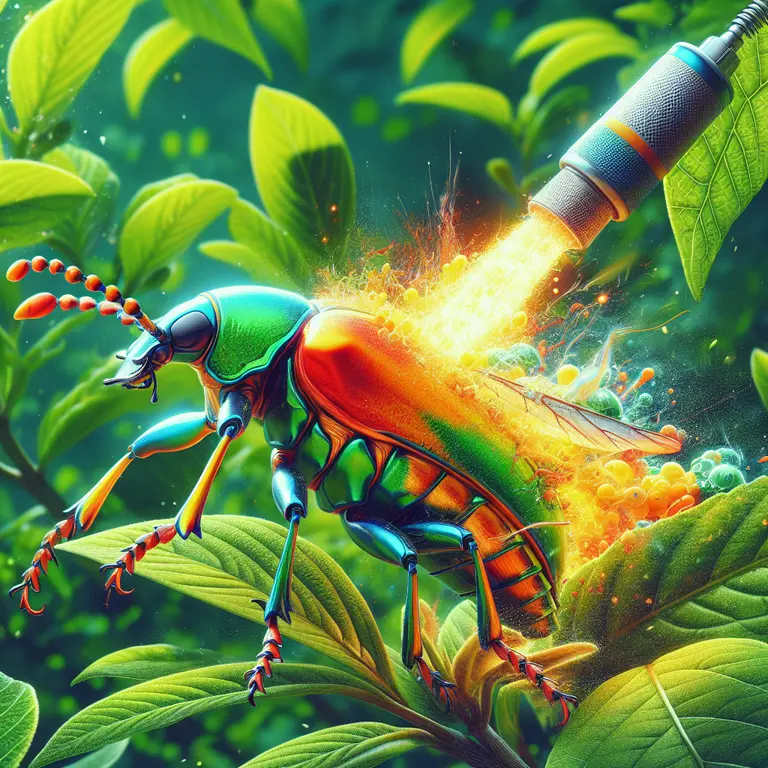
The Bombardier Beetle: Nature’s Living Chemical Weapon
Few creatures in the natural world demonstrate the ingenuity of evolution quite like the bombardier beetle. Distributed across more than 500 species, these insects inhabit environments spanning North and Central America, though related species have been identified on every continent except Antarctica. At first glance, they appear unremarkable — small, ground-dwelling beetles that blend easily into forest floors and grasslands. But concealed within their abdomens is one of the most sophisticated and lethal defense systems ever documented in the animal kingdom. The bombardier beetle does not flee danger quickly, nor does it rely on camouflage or mimicry. Instead, it fights back with a precisely aimed burst of boiling, corrosive chemicals — a weapon so effective that it has puzzled and fascinated scientists for generations.
The Chemistry Behind the Blast
To understand what makes the bombardier beetle so extraordinary, it helps to begin at the molecular level. Inside the beetle’s abdomen are two separate storage chambers, each containing a distinct set of chemical compounds. The first reservoir holds a mixture of hydroquinones and hydrogen peroxide. The second contains a collection of biological catalysts, primarily enzymes known as catalases and peroxidases. Under normal conditions, these two chemical sets remain safely isolated from one another. When the beetle perceives a threat, muscular valves open, allowing the contents of both chambers to combine in a third structure called the reaction chamber.
What happens next is a rapid and violent exothermic reaction. The enzymes break down hydrogen peroxide into water and oxygen gas while simultaneously oxidizing hydroquinones to toxic compounds called benzoquinones. The reaction generates an enormous amount of heat in an extraordinarily short period of time. The temperature inside the reaction chamber rises to approximately 100 degrees Celsius — the boiling point of water — within milliseconds. The resulting pressure from the rapidly expanding gases forces the mixture outward through an opening at the tip of the abdomen in a series of rapid pulses. Each discharge is accompanied by a distinct, audible popping sound, which may itself serve as an additional startling mechanism for would-be predators.
This is not a single continuous spray but rather a pulsed ejection, with some species firing at rates of up to 500 pulses per second. Research using high-speed X-ray imaging conducted at the Argonne National Laboratory in the United States has revealed the internal mechanics of this process in extraordinary detail, showing how the inlet and outlet valves of the reaction chamber open and close in rapid succession to produce these pulses. The pulsing mechanism is more efficient than a continuous spray, allowing the beetle to deliver a more sustained and thermally intense discharge without overheating its internal tissues.
Surviving Your Own Weapon
Perhaps the most counterintuitive aspect of the bombardier beetle’s defense is the fact that it survives it at all. The beetle is essentially detonating a near-boiling chemical reaction inside its own body on a regular basis, yet it emerges from each encounter entirely unharmed. This raises an obvious biological question: how does the insect avoid destroying itself in the process?
The answer lies in a combination of structural engineering and biochemical adaptation that researchers are still working to fully understand. The walls of the reaction chamber are lined with a cuticle that is resistant to both the corrosive chemicals and the extreme heat generated during the reaction. The chamber itself is positioned and insulated to limit heat transfer to surrounding tissues. Additionally, the pulsed nature of the discharge plays a protective role — by releasing pressure in short bursts rather than one sustained explosion, the beetle prevents a catastrophic buildup of heat and pressure that could rupture the chamber walls.
There is also evidence that the beetle’s hemolymph, the insect equivalent of blood, contains compounds that provide some degree of chemical protection to internal tissues. The outer tissues near the ejection point appear to have a higher tolerance for thermal stress than would be expected in most insects. This combination of physical structure and biochemical resilience represents a level of biological engineering that has no direct parallel elsewhere in the insect world. Engineers and materials scientists have taken note, studying the beetle’s reaction chamber as a potential model for designing more efficient pulse combustion systems and micro-scale chemical reactors.
Precision, Targeting, and Predator Deterrence
The chemical payload alone would be impressive, but what truly elevates the bombardier beetle’s defense to the level of the remarkable is the degree of control it exercises over that payload. The beetle can rotate its abdomen through an arc of up to 270 degrees around its longitudinal axis, giving it a firing range that covers nearly every direction without requiring it to reposition its entire body. This means the beetle can continue moving, or even remain stationary, while directing its spray with considerable accuracy toward the source of a threat.
This directional precision has been demonstrated in laboratory settings where beetles were provoked from various angles. In nearly every case, the spray was directed toward the point of contact or disturbance rather than fired indiscriminately. Against small predators such as ants and spiders, even a partial hit is typically sufficient to cause irritation and disorientation, allowing the beetle to escape. Against larger animals, including frogs and toads, the spray has been observed to cause immediate rejection responses. There are documented cases of toads that swallowed bombardier beetles and subsequently regurgitated them alive — the beetle having discharged its chemical defense from inside the predator’s stomach, forcing the toad to spit it out undigested.
This interaction with larger predators illustrates an important secondary function of the defense mechanism. Beyond immediate deterrence, the spray appears to create lasting aversive associations in animals that survive the encounter. Predators that have been burned or sickened by a bombardier beetle are far less likely to attempt another attack on a similar-looking insect in the future, effectively turning each encounter into a lesson in avoidance behavior.
Evolutionary Origins and Scientific Debate
The bombardier beetle’s defense system has attracted attention not only from biologists but also from those interested in the broader philosophical and scientific questions surrounding the evolution of complex traits. The mechanism is often cited in discussions about irreducible complexity — the argument that certain biological systems are too intricate to have evolved gradually because removing any single component would render them nonfunctional. Proponents of this view have pointed to the bombardier beetle as an example of a system that could not have evolved step by step.
However, evolutionary biologists have largely rejected this interpretation. Research has shown that each component of the bombardier beetle’s defense system has plausible evolutionary precursors. Many beetles produce quinones as a basic chemical defense, and hydrogen peroxide is a common byproduct of normal metabolic processes in insects. The enzymatic reaction chamber likely evolved incrementally from simpler glandular structures that were already present in ancestral beetle lineages. What makes the bombardier beetle extraordinary is not that its system appeared fully formed, but rather that natural selection refined and integrated these existing components into something of remarkable sophistication over millions of years.
The fact that similar, though less complex, chemical defense systems appear in related beetle families supports the gradualist evolutionary account. The bombardier beetle represents the current endpoint of a long trajectory of incremental improvements, each of which provided some marginal survival advantage to its possessor.
Conclusion
The bombardier beetle stands as one of nature’s most compelling demonstrations of what evolution can produce when survival pressure is applied consistently over vast stretches of time. It has transformed ordinary biochemical processes — enzyme reactions, pressure dynamics, glandular secretion — into a weapon system of genuine sophistication. Its ability to synthesize, store, and deploy a boiling chemical spray with precision targeting, while protecting itself from the reaction it initiates, reflects a degree of biological engineering that continues to inform and inspire human technology. More broadly, the bombardier beetle reminds us that the natural world contains solutions to problems we have barely begun to ask, and that even the most unassuming creature may carry within it a story of extraordinary complexity.