
The Strange Tale of Lichtenstein and Its Fake Army
In 1866, the tiny nation of Liechtenstein sent 80 soldiers to participate in the Austro-Prussian War, but the story took a bizarre turn that remains lesser-known.
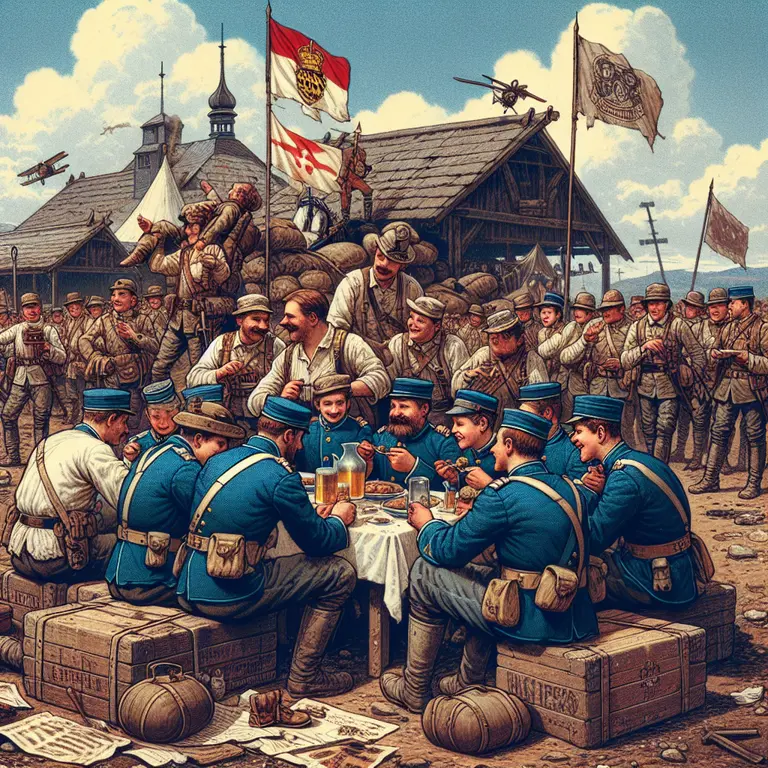
Liechtenstein’s Accidental Army: The War That Ended Before It Began
There are military histories that celebrate grand campaigns, decisive battles, and the courage of thousands. And then there is the story of Liechtenstein’s only expeditionary force, a tale so quietly absurd and yet so genuinely human that it has outlasted far more dramatic conflicts in the popular imagination. Liechtenstein, nestled between Austria and Switzerland in the heart of the Alps, is one of the world’s smallest and wealthiest nations. It covers barely 160 square kilometers and today holds a population of fewer than 40,000 people. Yet this diminutive principality produced one of the most unusual military anecdotes in modern European history, a story that says as much about the nature of war, diplomacy, and human connection as it does about the peculiarities of a tiny alpine state.
The Austro-Prussian War and Liechtenstein’s Reluctant Role
To understand how Liechtenstein found itself sending soldiers into a European conflict, it is necessary to understand the political landscape of 1866. The Austro-Prussian War, also known as the Seven Weeks’ War, was a defining conflict in the struggle for dominance over the German-speaking states of Central Europe. On one side stood the Austrian Empire, backed by several smaller German states and principalities. On the other stood the Kingdom of Prussia, led by the formidable Otto von Bismarck, whose ambition was nothing less than the unification of Germany under Prussian leadership.
Liechtenstein, as a member of the German Confederation, was obligated to contribute forces in support of Austria. It duly complied. On July 14th, 1866, the principality dispatched its entire expeditionary force: a contingent of 80 men. These soldiers were assigned to guard a mountain pass near the border with Italy, a posting that reflected both the strategic geography of the Alps and the relatively peripheral role that Liechtenstein was expected to play in the broader conflict. The assignment was not glamorous, but it was a genuine military deployment under Austrian command, and these men took it seriously.
What followed, however, was something no military planner had anticipated. The war moved with extraordinary speed. Prussia’s modernized army, equipped with breech-loading rifles and coordinated through an efficient railway network, defeated Austria decisively at the Battle of Koniggratz on July 3rd, just eleven days before Liechtenstein’s soldiers even set out. By the time the 80 men reached their position, the conflict was effectively over. The armistice was signed on July 26th, and the formal peace followed shortly after. Liechtenstein’s army had traveled through difficult mountain terrain, endured the hardships of a military march, and arrived at a war that had already ended. They had not fired a single shot, nor had a single shot been fired at them.
The Return Journey and the Legend of the Eighty-First Man
The soldiers returned home to Vaduz, the capital of Liechtenstein, and it was during this homecoming that the story acquired its most celebrated and enduring detail. According to the account passed down through generations, when the soldiers were counted upon their return, there were not 80 men but 81. Somewhere along the march through the Alps, the small force had acquired an additional companion, reportedly an Austrian soldier who had befriended the Liechtensteiners and chose to return with them rather than rejoin his own unit.
It should be noted that historians have debated the precise details of this episode. The core fact, that the army returned with more men than it departed with, appears in credible historical accounts, but the specific circumstances surrounding the extra soldier have taken on the quality of folklore over time. Whether the man was a deserter, a straggler, or simply someone who found genuine kinship with the small Liechtenstein contingent, the narrative has proven remarkably durable. The phrase that the army returned as a band of eighty-one has become something of a national legend, repeated in histories of the principality and in broader accounts of European military curiosities.
What makes this detail so resonant is not its military significance, which is essentially zero, but its human quality. In the middle of a war involving hundreds of thousands of soldiers, administrative machinery, and geopolitical ambition, a small group of men from a tiny mountain principality apparently made a friend. That friend followed them home. There is something quietly moving about that image, something that cuts against the impersonal scale of nineteenth-century European warfare and reminds us that armies are, at their core, collections of individual human beings navigating extraordinary circumstances.
Liechtenstein After 1866: The Path to Permanent Neutrality
The war had lasting consequences for Liechtenstein that extended well beyond its modest military participation. The dissolution of the German Confederation following Prussia’s victory left the principality in a peculiar position. It was no longer bound by the obligations that had required it to send troops in the first place. Rather than seeking new alliances or entanglements, Liechtenstein chose a different path entirely. In 1868, just two years after the war, the principality disbanded its standing army altogether. It has maintained no military force since then, making it one of only a handful of countries in the world with no army of any kind.
This decision was not made in a vacuum. Liechtenstein had observed firsthand how quickly a conflict could escalate, how little influence a small state had over the outcome of wars between great powers, and how costly military obligations could be for a nation with limited resources. The principality instead pursued a policy of strict neutrality, a posture that served it well through both World Wars of the twentieth century. During the First World War, Liechtenstein’s neutrality was complicated by its close economic ties to Austria-Hungary, and the country suffered significant economic hardship. But it was not invaded or occupied. During the Second World War, it remained similarly neutral, though it faced pressure from multiple directions and quietly provided refuge to a small number of displaced persons.
Today, Liechtenstein’s security is effectively guaranteed by its relationship with Switzerland, which manages its foreign affairs and with which it shares a currency, an open border, and a customs union. The principality has transformed itself into one of the world’s most prosperous small states, with a highly developed financial sector, low tax rates, and a standard of living that consistently ranks among the highest in the world. The decision to abandon military ambition in favor of economic development and diplomatic neutrality has proven, in retrospect, to be one of the most consequential choices in the nation’s history.
Why This Story Still Matters
It would be easy to treat Liechtenstein’s 1866 military expedition as nothing more than a historical footnote, a curiosity to be mentioned briefly before moving on to more consequential events. But the story has survived for over 150 years for a reason. It endures because it encapsulates something true about the relationship between small nations and the larger forces that surround them, and about the way human beings behave when the machinery of war grinds to a halt, and they are left simply to find their way home.
The episode also serves as a useful counterpoint to the mythology that tends to surround military history. Wars are often remembered through their most dramatic moments: the decisive charges, the heroic last stands, the turning points that shaped the course of nations. Liechtenstein’s story is the opposite of all that. It is a story about men who marched to a war that was already over, who came home without glory or grief, and who brought an extra friend along for the journey. In its own understated way, that is a more hopeful kind of military history than most.
For a country that has not fielded a soldier in more than 150 years, the legend of the eighty-first man remains a surprisingly rich piece of national identity. It speaks to values that Liechtenstein has made central to its modern character: the preference for connection over conflict, for practical wisdom over martial ambition, and for the quiet dignity of a small nation that has deliberately and successfully chosen to stay out of the way of history’s most destructive impulses. In a world still shaped by the consequences of large-scale military conflict, that is a story worth remembering.